
Hopkinsville City Directory Shelves
Hopkinsville city directory evidence does not sit in one complete online database. Printed holdings, a FamilySearch catalog record, Gale microfilm finding aids, and the National Archives each cover part of the run. The Hopkinsville-Christian County Public Library genealogy collection is the best local starting desk. The Christian County Historical Society is reported to hold business directories and telephone books, but its exact call numbers and latest telephone-book year need confirmation by appointment.
| Collection | Verified years | Where held | Access route |
|---|---|---|---|
| Meacham's municipal directory | 1897 | FamilySearch catalog; local shelf lead | Catalog viewer or library request |
| City business directories | 1897, 1899, 1907, 1910, 1912, 1914, 1916, 1922, 1924, 1926, 1928, 1930 | Historical Society lead and Athenaeum bibliography | Appointment; confirm volume first |
| Gale/UMI filmed set | 1910/11 through 1935/36, with stated gaps | Reels 9 and 10 | Library or reel-holding institution |
| NARA holdings | 1924–1931 and 1935 | National Archives finding aid | Repository-dependent |
| Telephone directories | Reported from 1900 onward | Christian County Historical Society | By appointment |
Start with the year closest to the event being researched. Note the missing years before drawing a conclusion from an absent name. The NARA city-directory finding aid and the Gale index identify holdings, not a complete free image set.
Hopkinsville's 1897 Directory Start
The earliest verified title is Meacham's municipal directory, 1897. The catalog credits A.B. Willhite and Charles M. Meacham and describes roughly 136 to 140 pages. Its viewer depends on JavaScript or a login, so the inspection did not expose a stable resident entry or abbreviation key.
The catalog proves the title and provides an access path. It does not support claims about fields on an unseen page. Ask HCCPL or a FamilySearch center to open the scan. Photograph or copy the title page, key, and complete entry before comparing later Hopkinsville city directories.
Note: Treat 1897 as the earliest verified lead here, not proof that no earlier directory ever existed.
Hopkinsville Directory Years and Gaps
The local bibliography lists a broken series rather than a yearly run. Gale reel 9 covers 1910/11, 1912, 1914, 1916 through 1918, and 1922/23. It marks 1919 through 1921 as missing. Reel 10 covers 1924/25 through 1931 and 1935/36, with 1932 through 1934 missing. NARA separately lists 1924 through 1931 and 1935.
| Period | Research meaning |
|---|---|
| 1897–1907 | Local bibliography and Meacham catalog leads |
| 1910/11–1922/23 | Gale reel 9, with a 1919–1921 gap |
| 1924/25–1935/36 | Gale reel 10, with a 1932–1934 gap |
| 1900 onward | Reported telephone-directory holding; exact run unverified |
A person missing in 1920 may simply fall inside a filmed gap. Move to the nearest volume, then check a census, newspaper, deed, or court index. There is no verified last printed Hopkinsville directory year in the inspected sources.
Reading Hopkinsville Directory Entries
A directory page must be read with its own key. Many municipal volumes arrange names alphabetically and may show a spouse, occupation, business link, street address, widow notation, or an owner/non-owner mark. Those are fields to check, not confirmed features of every Hopkinsville edition. Abbreviations vary by publisher and year.
- Name and initials: copy spelling and punctuation exactly.
- Spouse or relative: note parentheses and relationship marks.
- Trade or business: preserve the printed label and date.
- Street address: retain the old number and abbreviation.
- Status marks: consult the key before reading owner, widow, or deceased notation.
- Criss-cross directory
- A volume arranged by street or telephone number so an address leads to a listed name.
- Householder index
- An address-oriented list of the person the publisher treated as the household head.
- Abbreviation key
- The publisher's legend for shortened street, trade, and household terms.
Hopkinsville Archive Fills Directory Gaps
The Hopkinsville Digital Archives does not advertise a full scanned city directory run. It supplies other dated name sources: Kentucky New Era obituary cards from 1813 through 2021, obituary pages from 2005 through 2025, Hopkinsville High School yearbooks from 1916 through 2007, and a 1910 Christian County vital-statistics collection.
The archive reports 75,193 obituary-card pages and 1,475 yearbook pages. These are page counts, not resident totals. Search results vary sharply by decade. A thin period should send the researcher to microfilm or staff help, not support a claim that a person was absent.
The image below comes from the Kentucky Historical Society repository roundup, which describes Hopkinsville holdings.
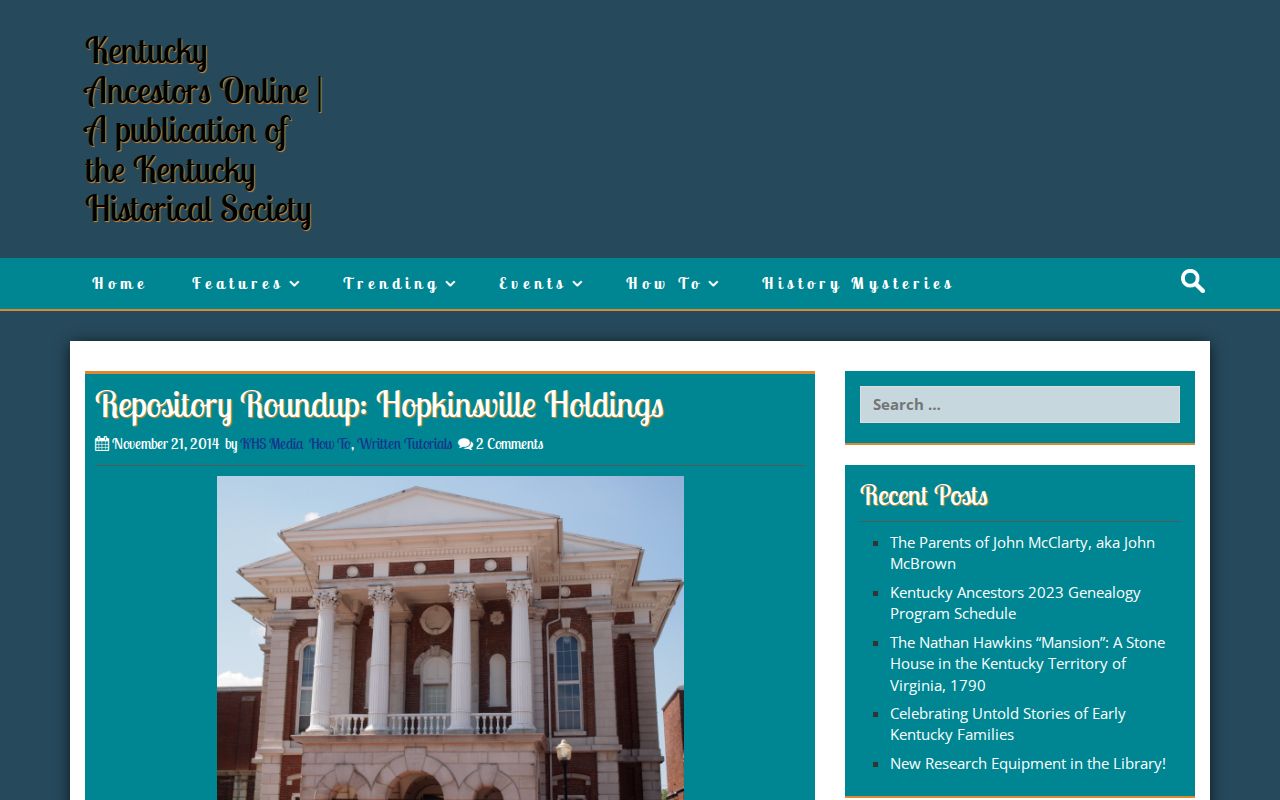
It identifies institutions holding directories, papers, photographs, yearbooks, and cemetery material when an online search stops.
Hopkinsville Library's Record Trail
Local access has changed for two centuries. Hopkinsville's library history runs from an 1816 library-company act to an 1874 reading room, the Hopkinsville Library Association in 1896, and a Carnegie building opened in October 1914. The Pennyrile Region followed in 1958. A joint city-county library formed in 1974, while the Bethel Street building opened in 1976 and was dedicated in 1977.
- 1816: a library-company act begins the documented trail.
- 1914: the Carnegie building opens on Liberty Street.
- 1974: city and county service joins in one structure.
- 1976–1977: the Bethel Street building opens and is dedicated.
This history explains why a newspaper reel, catalog card, or city directory may be at HCCPL rather than in a city portal. Its second-floor genealogy area, genealogy@hccpl.org, and 270-887-4262 form the local fallback. Staff-assisted research costs $25 per hour or portion under the available request sheet.
In-person research also reaches sources that do not have a stable public viewer. HCCPL offers licensed databases on library computers and can help identify local rolls. The Christian County Historical Society's former hardware-store building at 306 East Ninth Street holds the reported business and telephone directories, but access is by appointment and a current public contact route was not found. The Pennyroyal Area Museum at 217 East Ninth Street can supply the cemetery and local-history layer. A written HCCPL research request is the sound choice when travel is not possible. Give staff a full name, a narrow year span, an old street, and the exact volume already checked. That keeps the search focused and makes a negative answer more useful.
Trace Hopkinsville Families by Directory
A city directory supplies a dated public association, not a full household. Use it between federal census years and beside local news. Federal census schedules become public after 72 years, so older returns can confirm age, birthplace, relations, and nearby households that a short line omits.
- Begin with a known surname, year, or Hopkinsville street.
- Copy the full entry and the volume's abbreviation key.
- Check the prior and next available editions, allowing for gaps.
- Compare the nearest public census and street section, if present.
- Confirm the result in news, obituaries, deeds, court books, or vital indexes.
If a street label changed, consult Hopkinsville's official code trail for renamings recorded from 1984 through 2024. The claim of a 1909 citywide renumbering was not verified in an authoritative source. Preserve the old address rather than silently converting it.
Hopkinsville History Beyond Directories
The Christian County Historical Society adds letters, family papers, maps, local books, yearbooks, and glass negatives tied to a photographer active from 1858. The Pennyroyal Area Museum adds Riverside, Rosedale, and county cemetery inventories, African American obituary binders, census resources, and veteran profiles. Their strength is context and corroboration.
HCCPL lists Kentucky New Era microfilm from 1872 through 1983 and Hopkinsville Kentuckian from 1892 through 1919. HeritageHub and library-only Ancestry access extend the search. FamilySearch catalogs Christian County court orders from 1797 through 1915. KDLA can route deed, marriage, court, naturalization, census, and early vital research.
The NARA capture below explains how directories bridge the 1930 census. Open the National Archives directory resource before consulting its holding details.
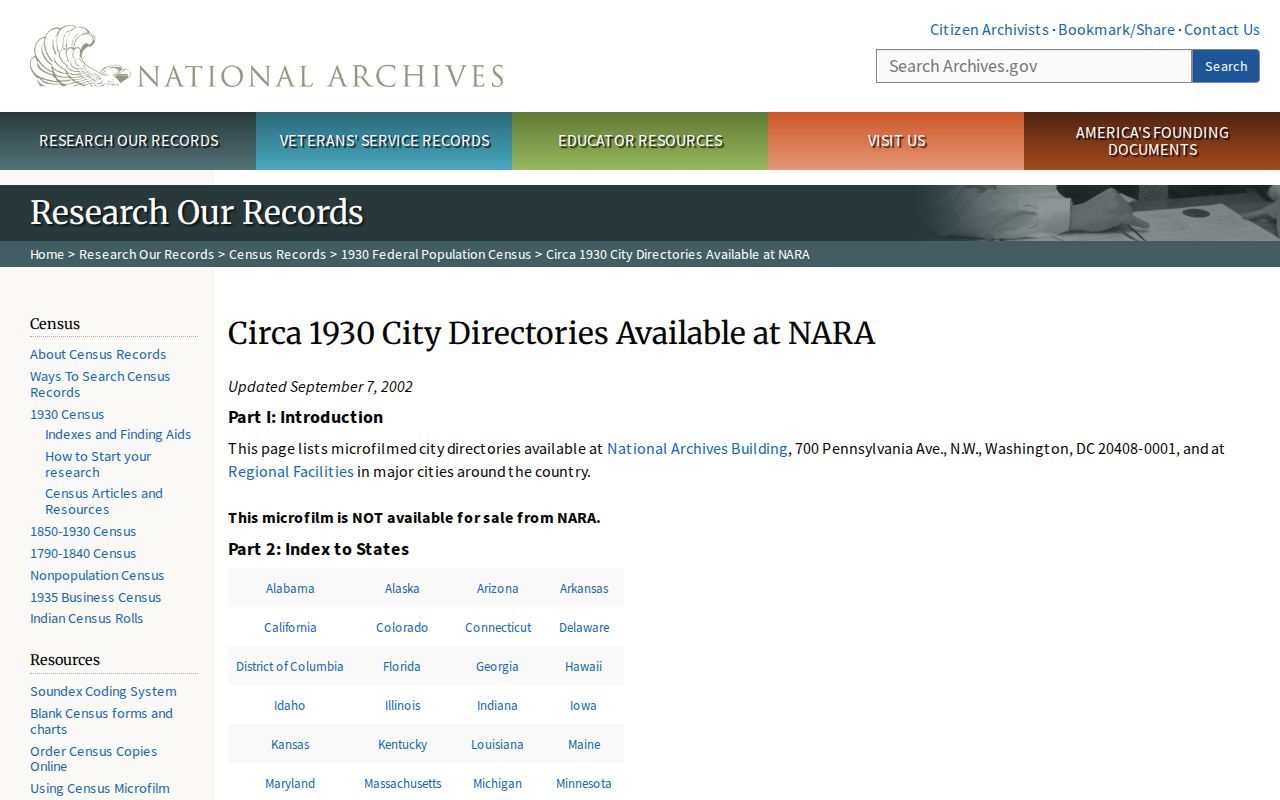
Use each directory as a dated lead, then verify the person and address in a separate record.